
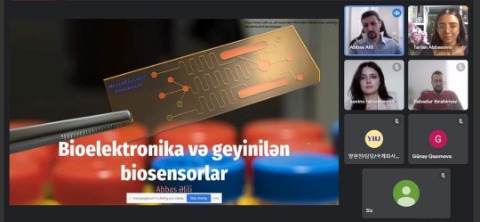
Baku Engineering University (BMU) and the State Program "2019-2023" jointly organized a webinar on "New trends in electronics engineering: Bioelectronics and Kobots" to promote engineering specialties in the country.
The main purpose of the webinar is to discuss the future prospects of electronics engineering, as well as to provide detailed information on admission to the international double degree program in Electronics Engineering at the undergraduate level of higher education by BMU and Inha University of the Republic of Korea.
The webinar was moderated by Tarlan Abbasova, a dual degree program specialist at the State Program Management Group. He gave general information about the "State Program to increase the international competitiveness of the higher education system in the Republic of Azerbaijan for 2019-2023", the establishment of international dual degree programs in priority areas for the country's economy between the world's leading universities and Azerbaijani universities. talked about.
The first speaker has 4 years of experience as a Senior Lecturer in Digital Electronics, Process Control for Engineers, Microcontrollers, and Control of Mechatronic Systems, 2 years as Head of the Internet of Things Laboratory, and is currently pursuing a PhD in Electrical and Electrical Engineering at North Carolina State University. Abbas Alili, who continued his education in "Computer Engineering". He made a presentation on "Bioelectronics and wearable biosensors." He said that bioelectronics is a very large field where new information processing systems and devices using biological materials and architectures are created. In his speech, Alili spoke about the fields of bioelectronics, the greatest requirements for biosensors, the composition of biofluids, as well as sensors worn on the epidermis.
Then Bahadur Ibrahimov, the founder and director of the Society of Robots and Automation in Azerbaijan, who has 3 years of experience as a program manager on robotics, made a presentation on "Cobots: Electronics, Robots and New Trends." He spoke about the Japanese company Konica Minolta, which has 45,000 employees worldwide. Ibrahimov noted that with the development of electronics, a new era of robots has begun. Speaking about the history of industrial robots, the speaker noted that industrial robots reduce production costs, increase accuracy and productivity. He also provided information on robot programming, collaborative robots and their advantages, universal robots and their advantages, the economics of non-contact and non-contact programming caused by the impact of the COVID-19 pandemic.
Sevinj Isgandarov, chief specialist of the BMU-INHA dual degree program, reminded that the program was launched last academic year. Noting that the program is based on the 3 + 1 model, S. Isgandarov noted that the admission is carried out in 4 specialties, and the program envisages the admission of 100 applicants in total. He said that entrants must collect the appropriate passing score for each specialty in the exam organized by the State Examination Center (SEC). Applicants must then successfully pass an oral English and subject competition (mathematics and physics) organized by BMU and Inha University. He added that the exams were conducted by Korean professors.
S. Isgandarov stressed that the "2019-2023 State Program" covers the tuition fees, registration costs, access to teaching materials and electronic information resources, as well as the costs of 1-year education and 3-week summer school in South Korea. He noted that students will be taught Korean language classes at BMU for a period of 3 years to develop relevant language skills, and they will take exams in the 2nd and 3rd academic years to obtain a TOPIC certificate, respectively. Students who successfully pass the exams will continue their education in Korean at Inha University in South Korea in the 4th academic year.
Isgandarov said that along with the students, the university's faculty will be sent to South Korea for two years in a row in each specialty and will be trained at Inha University.