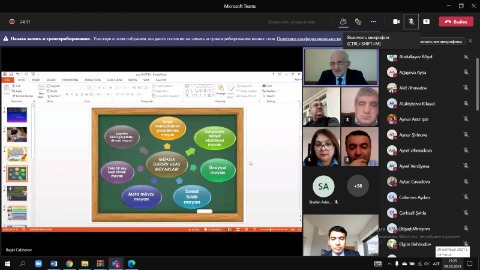
On October 29, 2021, the next lecture on the "Master Classes" project was held in accordance with the joint action plan adopted for the current academic year within the framework of cooperation between Baku State University (BSU) and Mingachevir State University (MSU). The lecture was attended by faculty members, students, masters and doctoral students of both universities.
The lecture, moderated online on the Microsoft Teams platform, was moderated by MSU Rector's Adviser Hamiz Mahmudov.
Rashid Jabbarov, Associate Professor of the Department of Social and Pedagogical Psychology, Faculty of Social Sciences and Psychology, BSU, made a report on "Modern lessons and its psychological problems."
In the report, Associate Professor R. Jabbarov spoke about the main content of the modern lesson and the psychological mechanisms of its organization. Talking about the contradictions in the study and their main reasons, R.Jabbarov gave detailed information about the creation of educational products, skills development, communication, social demand, discovery, self-realization and motivation as the main criteria of modern education, analytical and creative thinking. He spoke about the formation of a favorable educational environment that develops. There was a wide exchange of views on the report, which was met with great interest, and questions were answered in detail.
It was noted that the next lecture in the framework of the project, which provides for the organization of master classes on 10 different topics in October and November, was given on November 5 by the head of the Department of New Media and Communication Theory, Doctor of Philology, Professor Jahangir Mammadli. will be held on.
It should be noted that in order to strengthen the academic potential of MSU, special attention is paid to cooperation with BSU, one of the leading and oldest higher education institutions in the country. In order to increase the effectiveness of this cooperation, a multifaceted joint action plan is being implemented between the universities.
Aimed at the comprehensive development of students and graduate students, academic and administrative staff, this action plan includes master classes, conferences, round tables, scientific seminars, trainings, exchange of experience and student-oriented events of various contents.